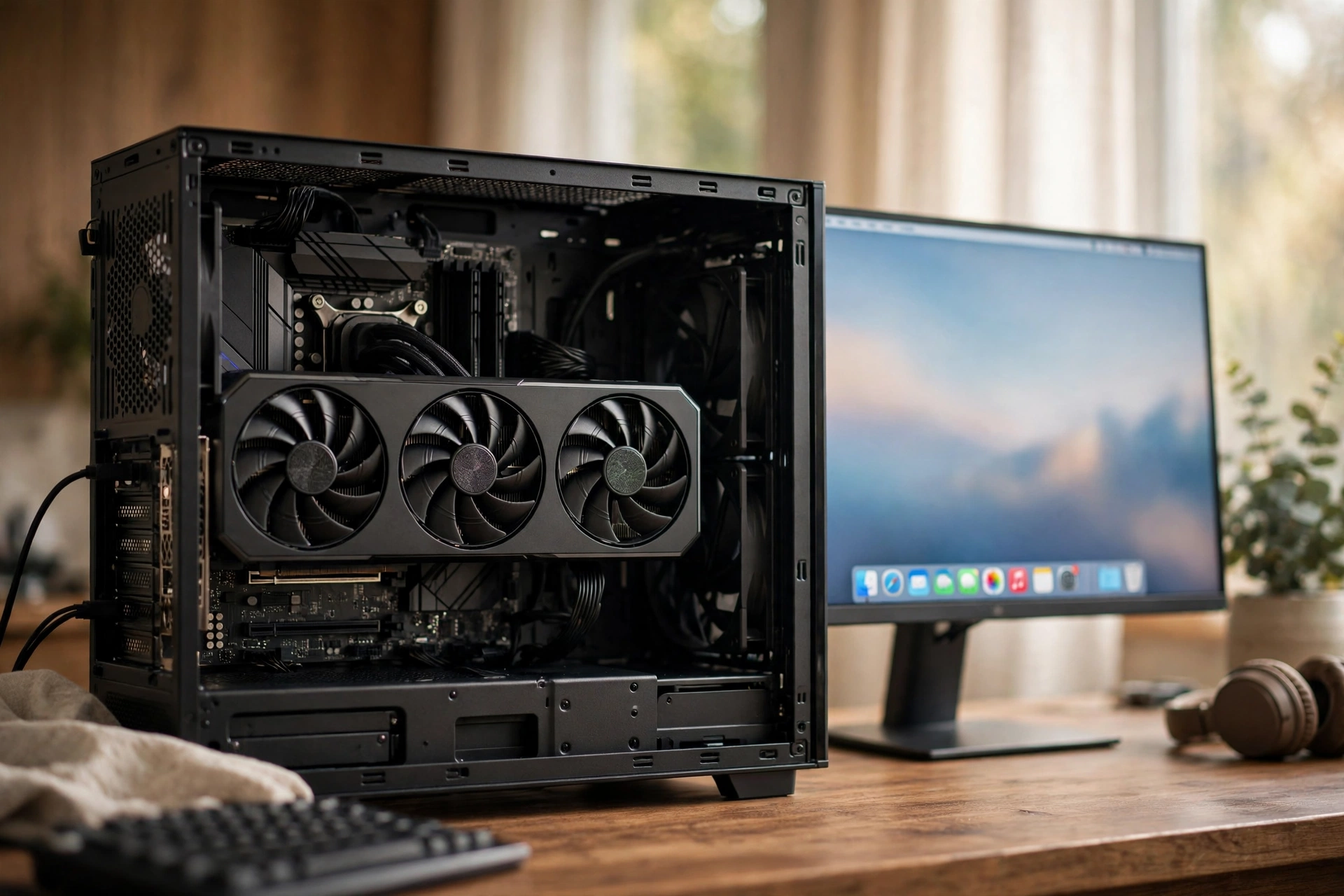
Apple’s AMD graphics drivers stop at RDNA 2. Every Radeon card newer than RDNA 2 has been a paperweight for macOS users. It may show a picture through a framebuffer driver. It has no acceleration, no Metal support, and nothing that makes the system usable as a daily machine. For anyone building a Hackintosh with a current-generation AMD card, this has been the end of the conversation.
A project called Cobalt64 aims to change that. Cobalt64 is an open-source driver that brings native Metal acceleration to AMD Radeon GPUs Apple never supported, starting with the RX 9070 XT. The project has been developing quietly since October 2026. It gained notice in late October when its code repository began to circulate. It is still a preview. You cannot install it yet. What Cobalt64 has already achieved on a test machine is the most promising AMD news the Hackintosh community has seen in many years.
Key takeaways
- Cobalt64 is an open-source driver that brings native Metal acceleration to AMD Radeon GPUs Apple does not support, starting with the RX 9070 XT (RDNA4, Navi 48).
- On one test PC, Cobalt64 already runs a GPU-composited desktop on three displays, with built-in macOS apps rendering through the driver.
- Cobalt64 is still a preview. There is no public release yet, no installer, and the author clearly says not to try installing it today.
- RDNA 3 and RX 7000 cards are future work, not part of this first effort.
- If Cobalt64 ships, the RX 9070 XT becomes an option for Hackintosh builders for the first time.
In this article
- What Cobalt64 is
- What works so far
- How it compares to NullMoth and the other community drivers
- Can you install it yet?
- What it means for Hackintosh builders
- Common questions
What Cobalt64 is
Cobalt64 is a graphics driver stack for macOS that is made for AMD Radeon cards Apple has not supported. Apple’s drivers cover AMD GPUs up to RDNA 2, the RX 6000 series. Any newer card, such as the RX 7000 or RX 9000 lines, gets no acceleration from Apple. Cobalt64 fills that gap with its code. The code is released under the MIT licence. The home page is cobalt64.com. The source code is on GitHub.
The stack has three layers. The lowest layer is a kernel driver, a bring-up kext that talks directly to the card. It sets up the PCIe connection and resizable BAR, finds and starts the GPU’s blocks, and drives the display engine. Above the kernel driver is a port of Mesa’s RADV Vulkan driver for macOS. That driver does the graphics work. On top of that is a Metal bundle. The Metal bundle runs Apple’s Metal API on top of the Vulkan driver, so macOS apps and WindowServer see a Metal device. Shader code is translated from Apple’s AIR format to SPIR-V during this process.
The first card the project supports is the Radeon RX 9070 XT, the Navi 48 chip that sits in AMD’s RDNA4 family. All development and testing are done on that card now. Other families, such as RDNA 3 and the RX 7000 series, are planned for later. Much of the stack is shared. Each GPU generation needs its own display and power-management bring-up, and someone with that hardware must test it.
Cobalt64 does not start from scratch. It builds on community work, including the RDNA4FB display-only driver and the mac-amdgpu bring-up project, plus Mesa’s RADV code and the Linux amdgpu driver’s register knowledge. The project states this openly in its credits. It is independent of AMD and Apple.
On 12 October the RDNA4FB team, now AMDRadeonRDNA4, invited Cobalt64 to work together. RDNA4FB covers display and compute. Cobalt64 covers Metal compositing.
What works so farOn an x86_64 test PC with an RX 9070 XT, Cobalt64 has reached a GPU-composited desktop on three displays at once. The PC runs macOS Tahoe 26.6.2 and boots through OpenCore. One display connects over DisplayPort, two over HDMI. WindowServer’s Metal compositor runs on the driver stack. The built‑in applications: Maps, Preview, Photos, System Settings and Music already render through it. Resizable BAR works. The driver arms itself at boot.
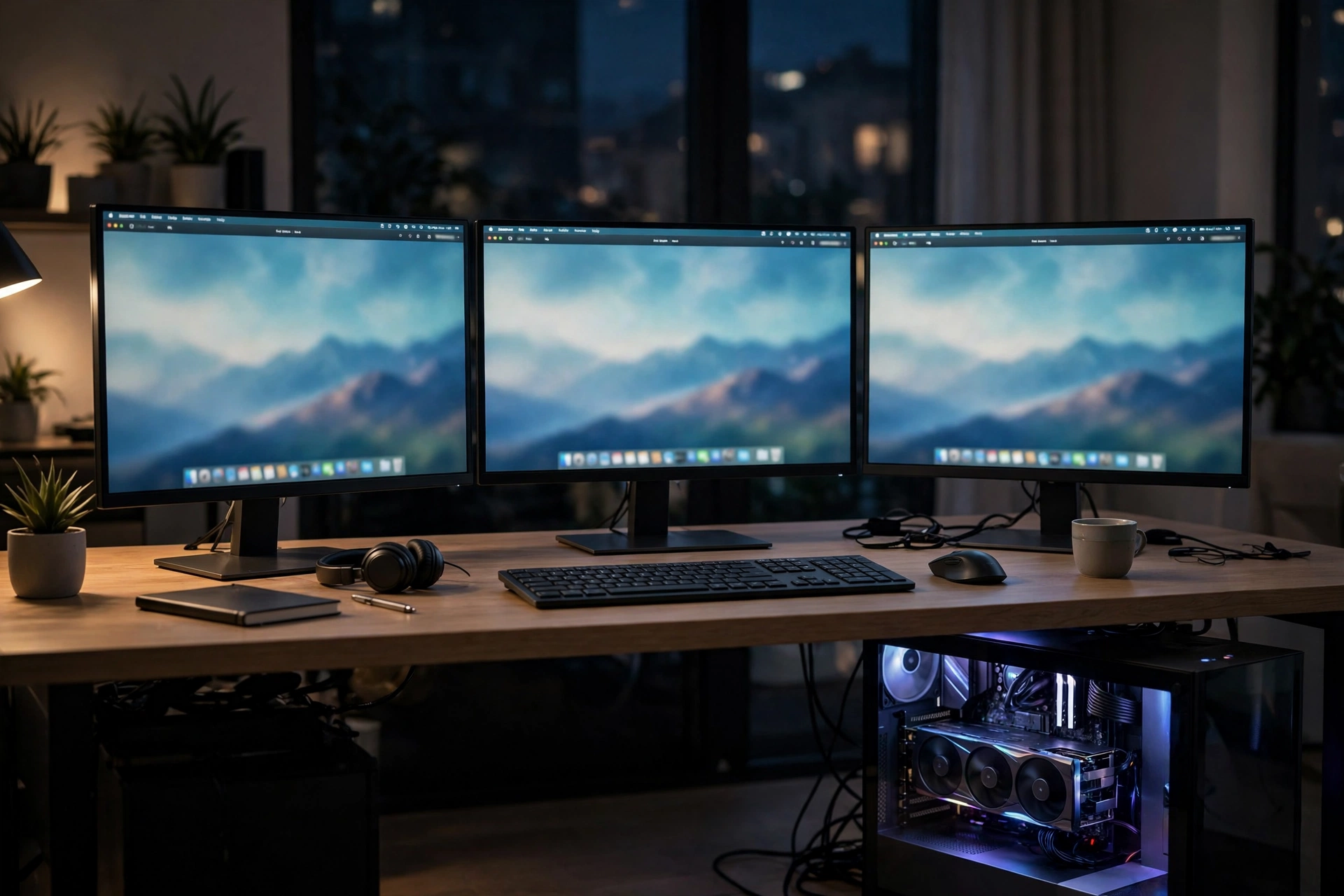
That is a result, not a screenshot of a framebuffer. The GPU is doing the compositing, which is what turns a demo into a driver.
It is still a preview. Here is where it stands:
| Area | Status |
|---|---|
| GPU-composited desktop, 3 displays | Working on the test PC |
| Built-in apps (Maps, Preview, Photos, Settings, Music) | Rendering through the driver |
| Resizable BAR, driver arming at boot | Working |
| 4K output over HDMI | In progress |
| Frame pacing and higher refresh rates | In progress |
| More apps (Safari, Chromium and Electron apps) | In progress |
| Display modes from each monitor’s EDID | In progress |
| Hardware video decoding | In progress |
Display modes are still limited to what the test PC’s monitors need, and many parts work around one specific macOS build. The project is 17 commits into its public repository, with 166 stars and no releases yet. Treat it as a project to watch, not a driver to install.
How it compares
Cobalt64 is the third community GPU driver of this new wave. Each one fills a gap in macOS support.
| Project | Hardware | Approach | Status |
|---|---|---|---|
| Apple native AMD drivers | Radeon up to RDNA 2 (RX 6000) | Official Apple kexts | Complete, but frozen at RDNA 2 |
| NullMoth | NVIDIA GTX 16 / RTX 20–50 series | Native Metal driver on NVIDIA’s open kernel modules | Shipping: version 2.5.4, near daily-driver use |
| nullarc | AMD RDNA3 integrated graphics (780M, 680M) | Metal-to-Vulkan layer | Early, iGPUs only |
| Cobalt64 | AMD RDNA4, RX 9070 XT (Navi 48) | Kernel driver + RADV Darwin port + Metal-on-Vulkan | Preview, no release yet |
NullMoth is the closest comparison. A year ago the idea of a community NVIDIA driver for macOS seemed unlikely; today NullMoth is on version 2.5.4 and running RTX 5080 cards with full acceleration. Cobalt64 is attempting the same trick on the AMD side, for a card family Apple never shipped in any Mac. Both follow the same pattern: a kernel driver wakes the hardware, a translation layer speaks Metal, then the hard part is the display and media details.
The difference is that NullMoth builds on NVIDIA’s open kernel modules, which do a large part of the low-level work. Cobalt64 has no help from AMD: its bring-up kext does the PCIe setup, power management, and display work itself, informed by the Linux driver. That is a harder road, so do not expect a fast public release.
Can you install it yet?
Not yet. The project’s own answer is short: wait for the first public release, which will come with an installer and a step-by-step guide on cobalt64.com. The repository today is source code, and running it requires a lot of setup on a separate macOS install.
Installing a preview GPU driver on your only macOS install is how you lose a weekend and possibly a bootable system. Kernel drivers write directly to hardware. This one is 17 commits old. If you want to follow the project, watch the repository and the website for the release, and check the supported-cards page before you buy anything.
When the release finally comes, the installation process will feel familiar to anyone who has used NullMoth. It will involve an OpenCore-based install, a kext, a Metal bundle, and a guide written for people who have built a Hackintosh before. Until that time, the RX 9070 XT will remain outside the Hackintosh compatibility list.
What it means for Hackintosh builders
If Cobalt64 ships, it changes the GPU options for a Hackintosh build. Today a builder who wants a current-generation card has two paths: an NVIDIA card with NullMoth, or an older AMD card that Apple still supports. A working RX 9070 XT driver adds a path, and a useful one. The RX 9070 XT is a current, available, sensibly priced card with 16 GB of memory, and it is the kind of card people actually buy for a new build.

Apple’s AMD support is frozen. Every year the gap between the newest Radeon card and the newest one macOS supports grows by a generation. Community drivers close that gap. NullMoth closed it for NVIDIA; Cobalt64 is the attempt to close it for AMD. If both survive, the Hackintosh GPU market stops shrinking and starts growing again.
None of that is guaranteed. Preview drivers fail, authors move on, and display and video-decode work is where these projects usually stall. Today, Cobalt64 is the most interesting AMD project in the scene, with real results on real hardware and a clear path to a first release. Watch it, do not buy hardware for it yet, and check back when the installer exists.
Common questions
Will Cobalt64 work on my RX 7000 card?
Not in this first effort. The project targets RDNA4 and the RX 9070 XT only. RDNA 3 and RX 7000 cards are listed as future work. Much of the stack carries over. Each generation needs its own display and power-management bring-up, and someone with that hardware needs to test it.
Does it work on Apple silicon Macs?
No. Cobalt64 is a Hackintosh driver for x86_64 PCs running macOS through OpenCore. Apple silicon Macs have their own GPUs with Apple’s own drivers, and there is no way to fit a Radeon card into one.
Is it safe to try?
Not yet. The project says so itself. There is no installer and no release. Running the source today needs setup on a separate macOS install, and kernel drivers write directly to your hardware. Wait for the public release and its guide.
When is the first release?
There is no date. The Cobalt64 repository has no releases listed. The project says only that the first public release will come with an installer and a guide on cobalt64.com. Five things have to land first: 4K HDMI, smoother frame pacing, Safari support, EDID display modes, and hardware video decode.
How is this different from NullMoth?
NullMoth brings modern NVIDIA cards to macOS; Cobalt64 brings modern AMD cards. They solve the same problem for different hardware, and both are community projects built outside Apple. If you already run an NVIDIA card with NullMoth, Cobalt64 changes nothing for you today. If you have been waiting for a current AMD card to work on macOS, Cobalt64 is the project to watch.
Sources: Cobalt64 on GitHub and cobalt64.com. For the NVIDIA side of this story, see the NVIDIA macOS driver guide and the Hackintosh GPU compatibility list. For the other new frontier in the scene, the ARM Hackintosh post covers macOS 27 running on a Snapdragon laptop. Facts in this article were checked against the Cobalt64 README and repository on 25 October 2026.
Want a Hackintosh that just works?
Skip the forum threads. HackintoshBuilder installs, upgrades and fixes Hackintosh systems remotely, with a custom OpenCore EFI built for your exact hardware. Start with a free compatibility check.